The Ten Commandments and American History: Why Biblical Literacy Belongs in Public Education
And: The Five Why's, Taguchi Loss Function, Leading and Lagging Indicators applied to the 10 Commandments
A recent interview between Vice President JD Vance and Joe Rogan reignited the debate over the Ten Commandments in public schools. (1) During the discussion, Vice President Vance expressed support for displaying the Ten Commandments in classrooms, while Rogan questioned whether doing so would simply “push people away from Christianity.”
The conversation reflects a broader misunderstanding of what the Constitution actually permits.
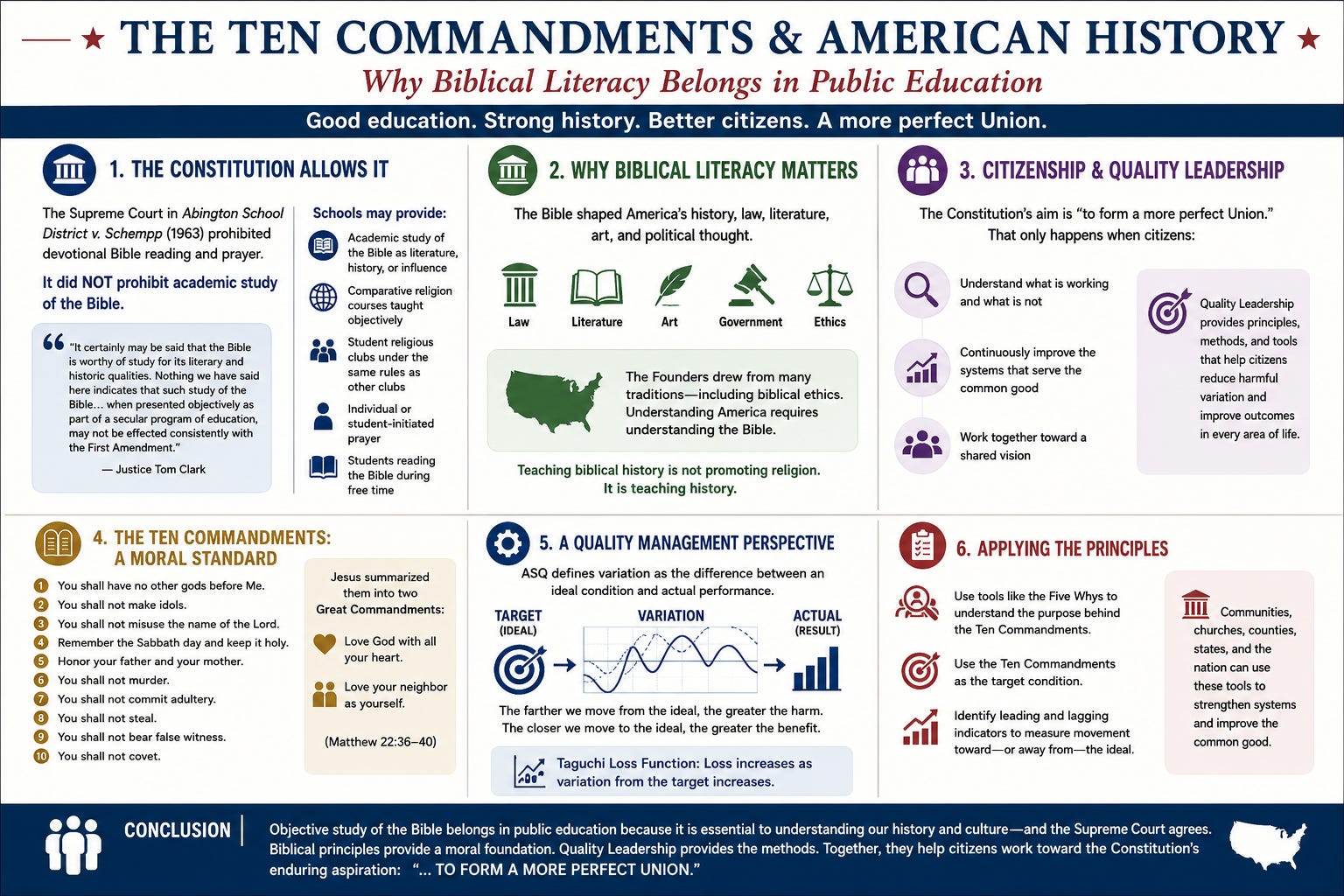
The landmark Supreme Court decision in Abington School District v. Schempp (1963) prohibited government-sponsored devotional Bible reading and prayer in public schools. It did not prohibit teaching about the Bible.
In fact, Justice Tom C. Clark, writing for the Court, made an important observation that is frequently overlooked:
“It certainly may be said that the Bible is worthy of study for its literary and historic qualities. Nothing we have said here indicates that such study of the Bible or of religion, when presented objectively as part of a secular program of education, may not be effected consistently with the First Amendment.”
The Court recognized an important distinction between religious instruction and academic study.
Under the Court’s guidance, public schools may constitutionally provide:
Academic study of the Bible as literature, history, or a source of cultural influence.
Objective courses comparing the world’s major religions.
Student-initiated prayer that does not imply government endorsement.
Students reading the Bible during free time.
Religious clubs operating under the same rules as other extracurricular organizations.
Far from excluding the Bible, the Court acknowledged its importance as one of history’s most influential books.
Why Biblical Literacy Matters
God is Love (1 John 4:8), and Love is willing the good of others in thoughts, words, and actions.
Whether one is a believer or not, it is difficult to understand American history, Western civilization, literature, art, law, or political thought without some knowledge of the Bible.
The Founders drew upon multiple intellectual traditions—including biblical ethics, English common law, classical philosophy, and Enlightenment thought. The Bible was one of the most widely read and widely quoted books in eighteenth-century America.
Students regularly study Homer to understand classical civilization. They study Shakespeare to understand English literature. Likewise, studying the Bible objectively helps students understand the historical and cultural foundations that shaped the American experiment.
Teaching biblical history is not the same as promoting religion.
It is teaching history.
Citizenship, Christianity, and Quality Leadership
The Constitution established a system of self-government whose purpose is summarized in its opening words:
“...to form a more perfect Union...”
A system, however, does not improve itself.
Its continued success depends upon citizens who are willing to understand what is working, identify what is not, and continuously improve the institutions and processes that serve the common good.
This is where Quality Leadership provides a practical framework.
Quality management teaches that every system has an aim, every process produces results, and improving outcomes requires reducing unnecessary variation from the desired condition.
In manufacturing, healthcare, education, and government, better systems consistently produce better results.
The same principle applies to citizenship.
The Ten Commandments as a Moral Standard
Quality management begins by defining the desired condition.
Without a target, improvement is impossible.
From a Christian perspective, God has established moral ideals that define healthy relationships with both God and neighbor. The Ten Commandments provide one of the clearest expressions of those ideals.
Found in Exodus 20 and Deuteronomy 5, they are:
You shall have no other gods before Me.
You shall not make idols.
You shall not misuse the name of the Lord.
Remember the Sabbath day and keep it holy.
Honor your father and your mother.
You shall not murder.
You shall not commit adultery.
You shall not steal.
You shall not bear false witness.
You shall not covet.
Jesus later summarized these commandments into two Great Commandments:
Love God with all your heart.
Love your neighbor as yourself.
These summarize the moral purpose behind the Law.
A Quality Management Perspective
The American Society for Quality (ASQ) describes variation as the difference between an ideal condition and actual performance.
Quality improvement seeks to reduce that variation.
Christians recognize a similar principle.
God establishes moral ideals, while human behavior often falls short of them. Every departure from those ideals carries consequences—not only for individuals but also for families, communities, businesses, and society.
Genichi Taguchi expressed a similar concept mathematically through the Taguchi Loss Function, demonstrating that loss increases as variation from the target increases.
The principle is remarkably consistent:
The farther we move from the ideal, the greater the harm.
The closer we move toward the ideal, the greater the benefit.
This principle applies not only to manufacturing but also to leadership, relationships, communities, and civic life.
One practical example is explored in my recent article:
The Ten Commandments, Five Whys, and the Taguchi Loss Function
Using quality management tools such as the Five Whys and the Taguchi Loss Function, the post illustrates how the Ten Commandments establish a target condition, why that target exists, and how communities can identify leading and lagging indicators to measure movement toward—or away from—that ideal.
Conclusion
The debate over the Bible in public schools should not be framed as a choice between education and religion.
The Supreme Court has already recognized that objective study of the Bible is entirely consistent with the First Amendment.
Biblical literacy enables students to better understand American history, Western civilization, literature, law, and many of the ideas that influenced the nation’s founding.
For Christians, the Bible also provides enduring moral principles.
Quality Leadership complements those principles by offering practical methods for continuously improving the systems and processes through which citizens serve one another and work together toward the Constitution’s enduring aspiration:
“...to form a more perfect Union.”
Teaching the Bible as part of America’s historical and cultural heritage is not government-sponsored religion.
It is good education.
End Notes
(47:20 Joe Rogan Experience #2526 - JD Vance, July 15, 2026
The 10 Commandments in the New Testament | The Love Jesus Taught
Comparison and Contrasts - Old Testament and New Testament
Acknowledgments: The ideas presented here were refined through an iterative process of study, reflection, discussion, and dialogue with artificial intelligence tools. In the spirit of continuous improvement, the conversation served as a catalyst for learning rather than as an authority. The resulting conclusions remain my own.
Introduction to the basic concepts, examples, and tools of quality at SuccessThroughQuality.com